
COBRAS IN PARADISE


From Paradise for King and Spitting Cobras to Oil Palm Plantations, this is nature’s exquisite balance.
I doubt if I will walk or cycle through Oil Palm plantations again, considering that there could be a King Cobra every couple of meters. Walking in the cool of the Oil Palms, my husband and I took a wrong turn, lost in the labyrinth of Oil Palm Plantations. Eventually late in the afternoon we found our way home. Later a friend told us that morning he had gone out onto his veranda to sit and enjoy his coffee. On his chair was coiled up King Cobra.
The King and Spitting Cobras are said to be the enigmatic guardians of the oil palm kingdom. The King Cobra helps balance the ecosystem by eating other venomous snakes.
Though the King Cobra is supposedly not an aggressive snake, they mainly enter the human settlements while chasing their prey. They are found in different colours from light green, black, brown and some combinations or mixture of all three. These snakes can see up to 300 feet away, so predators at a distance are at risk. Their sharp sight allows the King to thrive. A large King Cobra can look a full-grown human in the eyes, they are greatly feared by the locals, and can climb trees, swim, and move quickly across land.

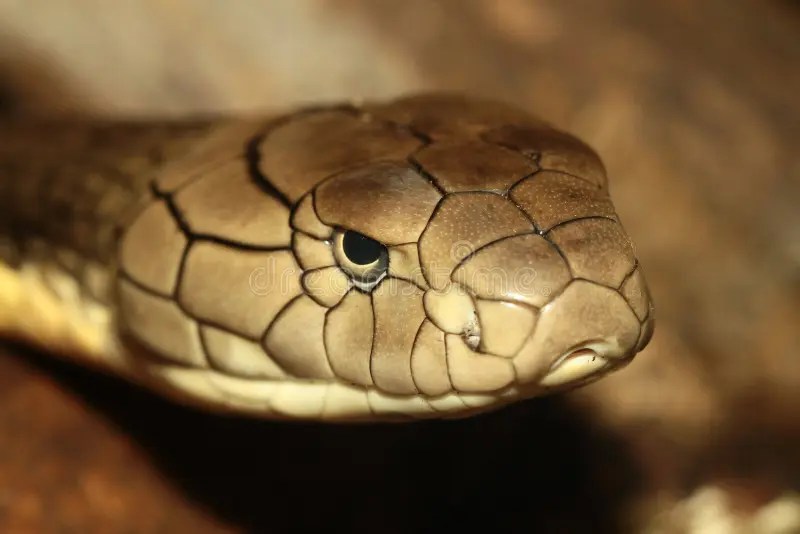
King Cobra
Most King Cobras are out in the morning after the sun rises and the outside temperature is slightly warmer.
A King Cobra will travel approximately 0.33 meters per second on the ground. One day when my husband was cycling in the oil palms, he saw what he thought was a log across the foot path, rear up into a striking position as he rode past. How lucky he was, and from this day forward he has never cycled in the oil palms again.
Indonesia has the second-highest number of snakebite incidents worldwide, resulting in over eleven thousand deaths annually.
You can site a cobra a day if you look hard enough. Locals climb the oil palm to harvest the fruit to sell. Often, they will also get spat in the eyes by a Spitting Cobra coiled up in a tree.
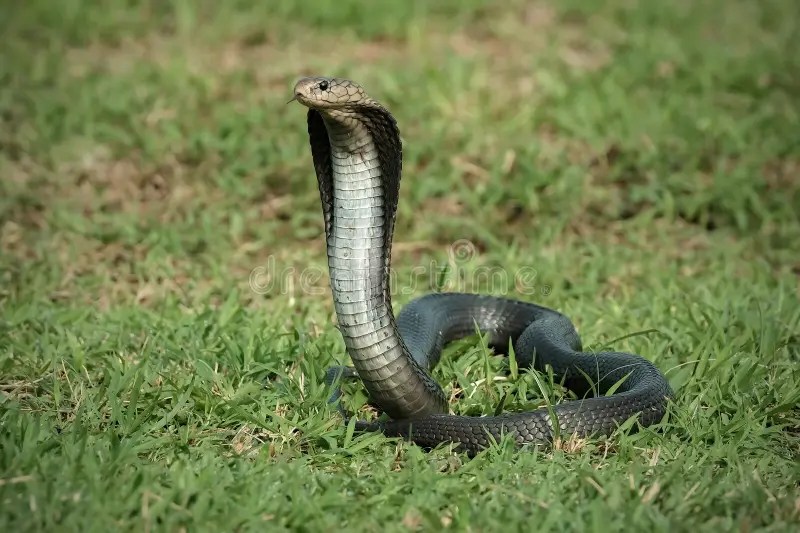

Javan Spitting Cobra.
These snakes are a vulnerable species and have been placed on the IUCN red list for protection, due to a massive trade in its skin, meat, and body parts.
A single snake bite contains enough venom to kill 20 people and can paralyse and kill animals as large as elephants.
The local people have learned to navigate the palm plantations with caution, respecting the Cobras’ territory, knowing the vital role they play in the ecosystem. So, the King and Spitting cobras of the oil palm plantations grow.
The King Cobra builds a nest of twigs and leaves, reaching a height of two feet. Within this nest it creates two distinct chambers, with the female residing in the upper chamber and diligently safeguarding her eggs in the lower chamber. This is a remarkably unique nest design, proving that the King Cobra may be one of the most intelligent snake species. My husband and I came across many of these mounds of twigs and leaves, not realising they possibly could be a King Cobras nest, with the female residing within.
Our responsibility is protecting the Earths biological riches. Like the mighty King and Spitting Cobras who are the guardians of the Oil Palm, creating natures exquisite balance. We must remind ourselves that we are entering their territory.
Written with respect for the forest and the lives it shelters.
 janiceekat57
 JungleLife by Kat
Thank you Peter.
LikeLike
G’day Janice,
Enjoyed that; thanks! Definitely sounds like palm-oil plantations are
not places to visit!
Blessings,
Peter
LikeLike